Thursday, January 13, 2011

The Co-operative Bank; good with money or fantastic for aviation?

From the Mule - 7th January 2010

Environmental activists have been angered by the news that the Cooperative Bank has taken part in a refinancing deal for the development of Manchester Airport. The bank will provide £40 million over the next 5 years to Manchester Airports Group despite its much-vaunted ‘Ethical Investments Policy’ which includes mitigating the threat of climate change as a central tenet.
The Bank’s policy states, “We will not finance any business whose core activity contributes to global climate change, via the extraction or production of fossil fuels (oil, coal and gas), with an extension to the distribution of those fuels that have a higher global warming impact (e.g. tar sands and certain biofuels).”
Zoe Creighton-Hird from Manchester Climate Action said, “If their ethical policy states that they won’t finance businesses that contribute towards climate change via fossil fuels then why do they finance businesses that do the same via emissions from aviation? It’s another case of aviation being ignored as a massive contributor to climate change and goes to show that the Coop’s environmental image is an illusion, if they are willing to invest millions into the fastest growing cause of carbon dioxide emissions.”
Manchester Airport is currently responsible for around 5 million tonnes of carbon emissions per year, making it one of the biggest polluters in the North West. It plans to demolish local homes to expands its operations, with the intention of doubling passenger numbers by 2030.
The Coop Travel arm of the business states the following on its website, ”We were the only travel agent to oppose the development of a third runway at Heathrow and we oppose the development of runways throughout the UK unless there is a clear sustainability case.”
The Cooperative Bank’s brand is based heavily its environmental credentials, in particular for its recent active role in opposing the tar sands project in Canada. While its ethical code is widely regarded as being at the forefront of conscientious banking, this move raises serious questions over the bank’s policies.
When contacted by the MULE, a spokesperson for the Cooperative Bank said, “The Bank’s Ethical Policy is based on consultation with our customers and reflects their ethical concerns.”
“Whilst we acknowledge that the climate change impact of various forms of transport are a concern to some people our Policy does not contain an explicit statement excluding finance for air travel related business.”
“We are, however, arguably one of the UK’s leading businesses in tackling climate change, through, for instance, our refusal to invest in fossil fuel extraction and production, procuring virtually all our energy supply from renewable sources and our, as part of our Toxic Fuels campaign with our customers and members seeking to halt the increasing trend towards exploiting fuels with a higher global warming potential such as tar sands.”
The finance deal with Manchester Airport Group totalled £280 million, with six other banks – Barclays, Handelsbanken, RBS, HSBC, National Australia Bank (through its subsidiary Yorkshire Bank) and Santander – providing £40 million each over a five year period.

Thursday, December 9, 2010

Day 2 of the trial: guilty verdicts, but the fight continues

Amanda Walters and Mark Haworth were found guilty this afternoon, but said that the campaign against the airport will continue.
Today the court heard the defence case, that the expansion of the Airport would have significant impacts on local homes and globally in contributing to climate change. Furthermore, the court heard how other methods of redress had been tried prior to the protest action in May 2010.
In February 2010, residents at Sipson Village – which was earmarked for demolition if the previous government had pressed ahead with plans to add a third runway to Heathrow Airport – joined forces with Manchester campaigners in a ‘twinning’ ceremony – which joined Sipson with Hasty Lane, a row of houses near Manchester Airport currently earmaked for demolition if expansion plans go ahead.
Speaking after the case, defendant Mark Haworth said, “The battle against airport expansion at Heathrow, Stansted and Gatwick was won because ordinary people came together, joined forces and took on the aviation industry. We’ve linked up with residents in Manchester and Heathrow and we’ll continue to challenge Manchester Airport’s expansion plans.”
Fellow defendant Amanda Walters said, “The judge accepted that our concerns were legitimate and that other means of making our views heard had been tried. Whilst the Council continues to impose expansion of the airport onto local people, we will continue to oppose it.”
A large part of the defence case focussed on the ‘reasonableness’ of the action given that other methods of redress had been explored. The witness statements of Manchester Councillor Martin Eakins and Hasty Lane resident Peter Johnson were read out verbatim by the Defence Counsel. In the statement, Eakins described his close involvement in the campaign to Save Hasty Lane, including making official representations to the Wythenshawe Area Committee, petitions and letters to national government.
From Cllr Eakin’s written statement:
“I feel that all democratic avenues were exhausted and I think it is reasonable to say that the only way avenue to achieve carbon reductions through traditional politics in this case was closed.”
In Peter Johnson’s written statement, he described his efforts to prevent his family home from being demolished.
From Peter’s written statement:
“We are now in a position where help and support from other areas in continuing to oppose the decision means that another route must be used if we are to halt this and/or further expansion already proposed or identified by the airport.”
Commenting on the verdict Peter Johnson said,
“I’m disappointed for the individuals who went above and beyond the call of duty – for a cause we should all be worried about. This isn’t just a matter of concern for those of us living at Hasty Lane – the expansion of the Airport will have effects on the whole of Manchester, and the world too. Sadly, actions like these are seldom recognised as being right at the time, but the fight continues.”
Mark Haworth and Amanda Walters were given a fine of £175 an £250 respectively plus were ordered to pay £460 in costs each plus a £15 ‘victim surcharge’ each.
Manchester Evening News coverage

Monday, December 6, 2010

The end of day one

So by the end of day one, the nine defendants pleading guilty, unable to bear the cost of a trial, were sentenced at 1pm today. The court heard how the protest had been a ‘response to a flawed planning process’ and the ‘democratic process being thwarted’. The judge handed out fines of on average £300 each before opening for the prosecution.
Ali Garrigan, from Manchester Plane Stupid, said “Today the defendants have taken responsibility for the protest, been accountable for their actions and will pay their fines. 


Meanwhile, Manchester City Council refuses to take responsibility for the emissions from the airport by excluding them from its Climate Change Action Plan and the aviation industry gets a free ride by paying no tax on its fuel.”


The trial continues tomorrow and is set to be an interesting day. Amanda Walters and Mark Haworth, the two defendants pleading not guilty, will be asked to tell the court what effects the expansion of the airport will have both locally, such as on the residents at Hasty Lane, as well as internationally in terms of CO2 emissions and climate change.


Local councillor Martin Eakins will also be speaking to highlight the local democratic deficit and resident Pete Johnson from Hasty Lane will talk about the threat to local homes.

Manchester Airport on Trial begins today!


Day 1

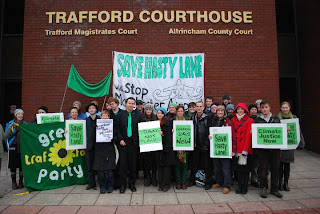
Huge show of support for defendants at Trafford Magistrates Court this morning for the first MAoT(Manchester Airport on Trial). Despite freezing temperatures people from all walks of life including Hasty Lane resident Pete Johnson came down to the courthouse with banners to wish the defendants well. 11 local campaigners are in court charged with willful obstruction of the public highway as a joint enterprise. Nine of the eleven are pleading guilty unable to bear the cost of the trial and two Amanda and Mark are pleading not guilty.

Margaret Westbrook a Trafford resident who came to court to support the defendants said 'the campaigners needed to take direct action due to the devastating environmental impacts of expanding Manchester Airport', she said 'it was a reasonable use non violent direct action to protest against the demolition of local homes and rising emissions especially since they have tried every other political avenue'.

Anne Power another Trafford resident expressed her dismay 'that people are so focused on the business side of the airport expansion and little thought is given to the homes that have to be knocked down or the biodiversity that will be lost.'

The campaigners believe the wreck less expansion of Manchester airport and the effects this is having on the local community and undermining our efforts to tackle climate change are worth risking legal sanctions. Their actions were further justified by the fact that official decision making channels had been exhausted and proven to be ineffective.

Friday, December 3, 2010

Nellie drops in on City Council’s climate change conference

On Tuesday 30th November, a cold and snowy morning, campaigners from Manchester Climate Action took a giant white elephant (lovingly named Nellie) to greet the public and organisations attending Manchester City Council's Climate Change stakeholder conference at the Museum of Science and Industry.

The first annual stakeholder conference aimed to engage with residents and businesses of Manchester about reducing their emissions. It was an initiative which came off the back of the council’s Climate Change Action Plan, named ‘Manchester: A Certain Furture’ (MACF), which was published in 2009 and took some important first steps towards considering the impact of our lives and industries on the environment.

Most significantly, MACF set targets for the city to reduce emissions 41% by 2020. However, as this commitment doesn’t include the flight emissions from Manchester Airport (55% owed by the city council and the regions biggest source of emissions) it seems a little feeble.

So the airport is still the council’s ‘elephant in the room’, and Nellie assisted campaigners in highlighting this, and embarrassing the city council. Everyone attending the conference, including the airport’s biggest supporter Councillor Richard Leese, was handed flyers explaining the elephant and detailing the councils omission of the airport from its climate change plan, as well as its plans to drastically expand over the next 30 years and demolish local homes to do so. Campaigners received a warm reception from both those attending the conference and staff at the museum who express their concerns about the council’s attitude towards the airport.

Sarah Thomas from Manchester Climate Action said “Although the city council are engaging with climate change and intends for the airport to be carbon neutral within the next two years this does not include the emissions from flights taking off or landing at the airport. Our concern is that if the council supports the airport in going ahead with plans to increase flights from 30 million flights a year to 50 million by 2030 then any emission reduction achieved elsewhere will be outweighed. Essentially residents and businesses in the city will be cutting their emissions in order for the airport to increase theirs.”

The event succeeding in getting new people and organisations discussing their emissions reduction plans - as well as the creative delivery of some of the six parallel workshops that happened throughout the day.

The protest was raised in a Mule interview with Councillor Nigel Murphy, Executive for the Environment at Manchester City Council:
MULE: The protestors in the lobby complaining that you’re ignoring the airport, do they have a point that you can’t really make a climate change plan for Manchester without considering the impact which the planes taking off from the airport have?

Nigel Murhy: We’ve never said that we don’t consider the effects but we’re trying to deliver where we can make change. As an organisation the airport are doing their own delivery plan. Airside emissions are not something we can change on our own in Manchester, there has to be an international agreement. More than happy for them to protest, but we’ve got to look at what we can change and what we can change now.


Nellie’s appearance at the conference took place just a week before 11 activists from Manchester Plane Stupid stand trial at Trafford Magistrates Court following their involvement in shutting down the airport in May 2010 in order to draw attention to the council’s plans to allow Manchester Airport to expand at the expense of demolishing local homes and destroying areas of important biodiversity. Their hearing begins on Monday 6th December 2010 and is expected to last one week.

A campaign titled ‘Manchester Airport on Trial’ is being run around the court trial and has received support from Heathrow Labour MP John McDonnell, Johann Hari, writer and journalist for the Independent, and Green Party MP Caroline Lucas. The campaign is playing an important role in highlighting to both the airport and council that people from all sectors of society are concerned about the planned expansion, and also that direct action is being increasing recognised as a legitimate way of opposing the plans due to the lack of effective democratic avenues.

Saturday, November 13, 2010

£100,000 payout as Manchester Airport runway hits value of houses

From Manchester Evening News - Friday 12th November 2010

By John Scheerhout


Two families have been awarded more than £100,000 compensation from Manchester Airport after being plagued by plane noise.
The couples took the airport to the Royal Courts of Justice in London claiming their lives were ruined by jets using the second runway, which opened in 2001.
And a judge ruled the value of their homes had been slashed since runway two opened.
Retired builders’ merchants Andrew and Annette Spark, who live in an Edwardian semi in Mobberley, were awarded £40,000.
After the ruling, Mrs Spark, said: “At times it’s an aerial bombardment.”
Their neighbours, Adrian and Kathleen Robertson, were awarded £72,500 after telling how the windows of their 19th century farmhouse are rattled by passing planes and it was impossible to hold a conversation in the garden.
The couples took the airport to the Upper Tribunal (Lands Chamber) of the Royal Courts where judge Andrew Trott said their account of vibration, fumes and ‘discharge of substances’ was not exaggerated and their evidence was ‘balanced and reasonable’.
Without the second runway, the Sparks’ home would be worth £515,000 and the Robertsons’ farmhouse £725,000, the judge ruled – 7.8per cent and 10pc respectively more than their current market value.
An airport spokesman said: “These were the only two of several hundred claims that were not settled by agreement. The claimants took their cases to the Lands Tribunal who have awarded them compensation and this award is in line with our own expert assessment.”