Showing posts with label wildlife. Show all posts

Saturday, November 3, 2012

Save Sunbank! Wildlife Walk


On Saturday 3rd November around 100 local residents and campaigners took part in a protest walk against the proposed World Logistics Hub at Manchester Airport. The protesters braved the cold to take a route around the 90 acre former greenbelt site, which is threatened by the plans to build 43 cargo sheds and almost 1,500 car parking spaces.

Local residents, wildlife enthusiasts and environmental campaigners spoke at various points along the walk, sharing their experiences of fighting Manchester Airport expansion and highlighting the numerous ways that the plans would affect local people and the environment.

The Wildlife Walk came the week after the Wythenshawe Area Committee‘recommended for approval’ the World Logistics Hub plans, on the 25th October.  The application will now be sent to the Planning and Highways Committee at Manchester City Council for a final decision on 22nd November 2012. A number of attendees at the Wildlife Walk, keen for their concerns to be brought to this Committee, pledged to attend this November meeting at Manchester Town Hall.

Several Councillors of the Wythenshawe Area Committee backed the Logistics Hub plans based on the Airport's promises of local job opportunities. However campaigners argue that job creation figures proposed by the Airport are inflated.


Jane Beetson from 'Stop Expansion at Manchester Airport' campaign  said “When Manchester Airport first announced plans for a second runway, they claimed 50,000 jobs would be created.  No-where near that number of jobs materialised.  Just like then, they are misleading the public now.”

She added, “Local Councillors say they will force the Airport to give jobs to local people but in practice they will have no way of enforcing this on the firms that move into the new office and warehouse spaces.  We need to create green jobs in sustainable industries not dirty aviation.” 

The Wildlife Walk was also an opportunity for wildlife experts to explain that Airport's promises of preserving wildlife are also unrealistic, and that creating a 'mitigation zone' is no substitution for leaving habitats untouched.


Along the route, campaigners encountered the threatened habitats of numerous plant and animal species. Several mature oak trees line Sunbank Lane, providing nesting opportunities for rare birds, and potential roosting spots for endangered bat species. The site is also home to 12 ponds occupied by Great Crested Newts, an endangered species found only in the North West of England. Walkers were also able to spot signs of protected animals for example badger snuffle holes and mole hills in the green space around Sunbank.

Manchester Mule coverage here.

Manchester Evening News coverage here.


Thursday, August 9, 2012

Manchester Airport unveils plans to concrete former greenbelt land with 'World Logistics Hub'

Manchester Airport has announced plans to concrete over former greenbelt land around Sunbank Lane to make way for a 'World Logistics Hub'.  The area is currently home to residential houses and greenfields and also borders onto Cotterill Clough - a Site of Special Scientific Interest.
Proposals to build on former greenbelt land
The plans involve the construction of around 43 warehouses and office units of various sizes on land adjacent to the A538, as well as 1,473 carparking spaces, 134 bike parking spaces and a re-landscaped green zone.   The plans form part of the wider Airport City Enterprise Zone.  More details can be found here: http://www.airportcity.co.uk/master-plan/world-logistics-hub/#

The Airport 'anticipate' that 1800 jobs will be created over a 15 year period.  However, a report on the wider Airport City proposals in Autumn 2011 by the Campaign to Protect Rural England found that many of these job creation projections actually involved displacing pre-existing jobs from elsewhere in Manchester, as firms relocate to take advantage of the cheap business rates on offer.

The land around Sunbank Lane was recently taken out of the Greenbelt in Manchester City Council's 'Core Strategy' which was approved in July 2012.  Many residents say they were not informed or consulted of these plans.  Audrey O'Donovan said,  "As a resident and chairman of Ringway Parish Council I am appalled at the lack of consultation by Manchester Airport when removing Oak Farm and surrounding area out of the green belt and changing the planning status enabling them to once again encroach on our countryside. All in the name of so called progress. What concerns me is the World Logistics Hub as they have called this latest expansion will expand to the other side of the A538 spreading their operations still further into our very small Parish of Ringway."

Plans for a World Logistics Hub to the south west of Manchester Airport

The Airport have published an 'informal' consultation document with images of the plans.   They say they intend to submit a formal planning application to Manchester City Council at some point in August 2012.  Objectors will have 21 days of formal consultation period to submit their views upon registration of the application.
A view of the area as it is now
Stop Expansion at Manchester Airport organised a 'Biodiversity Walk' around the affected site in May 2010.  Shortly after local activists blockaded the current World Freight Centre and staged an airside protest around the wheel of Monarch Airline jet against plans to expand the airport and demolish local homes. 

Thursday, May 26, 2011

Manchester Airport – it’s not for the birds

Over 100 employees at Manchester Airport have been given allotment plots, on the outskirts of the airport site, but still only a few hundred metres from the main runway. But the range of food that they can grow is restricted, fruit, or any other plant which might attract birds, is banned. Birds and airports are fundamentally incompatible. Bird strikes, aircraft collisions with birds, can endanger the flights, and are inevitably fatal for the birds as they are minced up in the plane’s engines. In the UK, 1,299 bird strikes were reported to the CAA Civil Aviation Authority in 2007.


On 29th April 2007, a Thomson Fly Boeing 757 with 221 passengers on board took off from Manchester airport on a flight to Lanzarote. Seconds after take-off two birds were sucked into the aircraft’s right engine. After dumping excess fuel the pilot retuned to the airport and made a safe landing using one engine. In this video you can see a bird being sucked into the engine, and the resulting fire. Fortunately the pilot was able to make a safe landing. Bird strikes can appear dramatic with the engines catching fire, but aircraft are designed to withstand this and few incidents result in serious accidents. Between 1988 and 2000, nearly 200 people were killed worldwide as a result of wildlife strikes. This is a small proportion of total air fatalities, which totalled 502 in 2008 alone.

All airports manage habitats on and around the site, in order to make the environment unattractive to birds, removing food sources including edible plants and grasses and shrubs which are habitats for worms and insects, treatment of grass along runways with insecticides and removal of shrubs and any other areas which could be used for nesting. But airports can still prove attractive for birds as the surrounding land is often undeveloped. In 2007 a seagull made a nest and incubated eggs on roof of a car in the long stay car park at Inverness Airport.

When habitat management fails to keep birds away, airports use a variety of methods to frighten them away from runways and flightpaths. Loud noises such as sirens, explosives, firearms and the distress calls of target species are played, and Manchester is one of many airports which uses falcons to chase smaller birds away. Birds can prove remarkably adaptable to all these attempts to frighten them away. When this occurs birds might be relocated, recently a flock of swans was relocated from the Docklands near London City Airport to the town of Windsor in Berkshire. But, frequently, birds which might endanger flights are killed, their eggs destroyed and their nests removed. In 2009, Manchester Airport was preparing for a cull of 800 rooks, one of the largest rookeries in Greater Manchester, in woodland near the airfield, where they had lived there for 300 years. There was a reprieve after an outcry and opposition from residents, bird watchers and the Royal Society for the Protection of Birds. 180 people signed a petition opposing the cull.

Posted by Rose Bridger

Monday, May 10, 2010

Biodiversity Walk at Manchester Airport


Sunday 9th May 2010

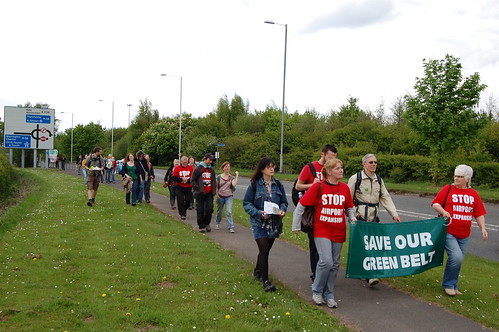
Around 60 people took part in the Biodiversity Walk organised by the Stop Expansion at Manchester Airport coalition. Local residents and campaigners visited green belt areas threatened by the planned expansion of Manchester Airport to learn about the habitats and species which are under threat.


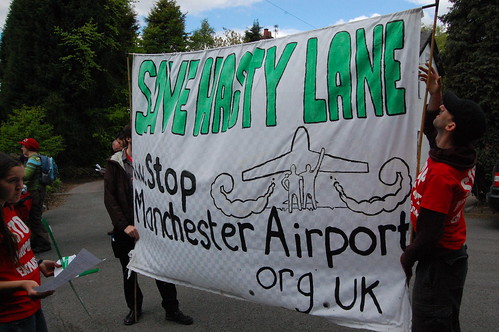
Members of other environmental campaigns around Greater Manchester came along to share their experiences of fighting to protect our natural landscapes from development. As well as a number of homes at Hasty Lane, several important habitats are either scheduled for destruction or likely to be badly affected by expansion plans.


On a family-friendly day out, residents and campaigners were able to see first hand some of the natural beauty still thriving in the shadow of the airport, as well as to learn from the Save our North West Green Belt and Save Chorlton Meadows campaigns about how best to build support and take on a process which too often disregards public opinion and environmental issues.


Manchester Airport has plans to remove areas such as parts of Sunbank Woodfrom the Greenbelt in order to build more carparks and freight sheds.  (Source:  Manchester’s Core Strategy, Manchester Airport Issues Paper, Refining Options Consultation April 2009 - page 8)  


The event is a continuation of the 'Adopt a Resident' scheme where campaigners have teamed up with threatened residents at Hasty Lane to help save their homes.

The areas visited included irreplaceable ancient woodlands directly adjacent to the site of planned development. These woodlands are home to a wide variety of plants and tree species as well as animals like badgers, foxes and buzzards. The proposed airport development would drastically alter the landscape in the area affecting for the survival of these woods.


Campaigners also visited an ancient pond which is home to a population of great crested newts, an endangered species found only in north west England. As well as the destruction of habitats like this, development can separate and isolate populations of a species; this interrupts the natural movement of animals and reduces their genetic diversity, harming their chances of survival.


Local biology enthusiasts explained how development has effects on biodiversity beyond the direct destruction of habitats, and how attempts by developers to offset the damage they cause are no substitute for leaving existing natural environments untouched. The areas earmarked for development should be protected by green belt status, but the airport seems determined to have this status removed to clear the way for development.

Hasty Lane resident Holly Johnson said, "This biodiversity walk aims to give people a visual experience of what airport expansion looks like. Not only is it bad for the climate and responsible for knocking down people's homes, it's also destroying beautiful green spaces. You cannot replace a 400 year old ancient woodland by planting some new trees down the road. That's not how biodiversity works."


Biodiversity enthusiast Alison Hunt said, "I never realised what historic and untouched corners of countryside still exist around the Ringway airport boundaries- ancient woodland and hedgerows, historic cottages and farms, tranquil fields and ponds. These hidden gems are now all threatened by the Airport's expansion plans to become the 'Heathrow of the North'."

DSC_0773

DSC_0716