Wednesday, June 30, 2010

Manchester Plane Stupid breach airside security

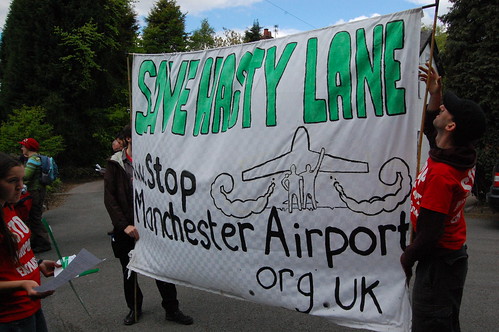
On Monday 24th May 2010, activists from the group Manchester Plane Stupid breached airside security at Manchester Airport in a protest against the expansion of the airport. The protest involved two groups. The first group of 6 people breached the perimeter fence and created a human circle around a stationary plane using arm tube lock-ons.


A second group used tripods to blockade the road entrance to the World Freight Terminal preventing airfreighted goods from being taken in or out. They have unfurled a banner reading: “More air freight = more climate change. Stop all airport expansion now.”

The group were protesting against the recent decision to expand the World Freight Terminal which will involve the demolition of historic homes on Hasty Lane.

Lisa Jameson from Manchester Plane Stupid said, “This isn't just about airport expansion or rising carbon emissions. This is about challenging an economic system based on the absurdity of infinite growth on a planet of finite resources, a system which prioritises bail-outs for the banks and then makes us pay for it in public service cuts. Capitalism is the cause of the problem, climate change is one of its many symptoms.”


Following the recent decision to stop expansion at Heathrow, Gatwick and Stanstead airports, the aviation industry is likely to look to regional airports such as Manchester to increase profits.

“The third runway at Heathrow was stopped because ordinary people stood up to the government at the time and the aviation industry using a broad range of tactics. Direct action has historically played an important role in creating social change and will continue to do so.”

The aviation industry consistently overstate their importance in creating jobs and their contribution to the economy.

The lack of tax on aviation fuel is costing the UK economy £9 billion per year. There is also a tourism deficit in the North West region of £2.2 billion. That is the difference between what Britons flying abroad spend in foreign countries and what foreign visitors spend in the North West.

Each round of airport expansion is justified on the promise of more and more jobs. In the 1990s Manchester Airport promised to create 50,000 jobs with the second runway – but the actual number was far lower. We need to begin a just transition to a low carbon economy by creating jobs in sustainable industries such as rail and renewables”


Annie McLaughlin said, “Recently, we've seen attempts by British Airways to use the courts to overturn workers' right to strike. We support the rights of all workers to fight for good conditions. It is essential that the changes needed to prevent climate change are not used as an excuse to restrict workers rights.”

McLaughlin continued, “The proposed expansion of the freight terminal makes no sense, economically or environmentally. The existing capacity is not fully utilized and an expansion would simply be a stepping stone to expansion of the airport as a whole, which would be an environmental disaster.”

“With the planet on the verge of climate breakdown it is essential that the real cost of aviation expansion is taken seriously – currently emissions from aviation are not included in Manchester City Council's Climate Change Action Plan.”

Press Links


The Guardian - on the wider movement against airport expansion - 25th May 2010


The Sun - 24th May 2010

The Daily Mail - 24th May 2010


Daily Mirror - 24th May 2010


Key 103 (Manchester Radio)

Sunday Mercury - 24th May 2010

Radio City - Liverpool

Airport International - 24th May 2010

Monday, May 10, 2010

Biodiversity Walk at Manchester Airport


Sunday 9th May 2010

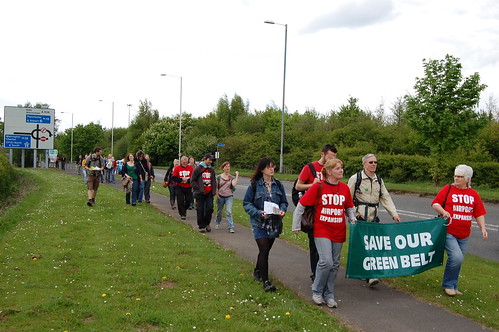
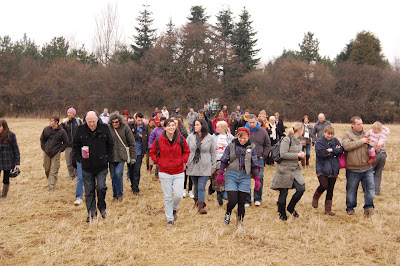
Around 60 people took part in the Biodiversity Walk organised by the Stop Expansion at Manchester Airport coalition. Local residents and campaigners visited green belt areas threatened by the planned expansion of Manchester Airport to learn about the habitats and species which are under threat.


Members of other environmental campaigns around Greater Manchester came along to share their experiences of fighting to protect our natural landscapes from development. As well as a number of homes at Hasty Lane, several important habitats are either scheduled for destruction or likely to be badly affected by expansion plans.


On a family-friendly day out, residents and campaigners were able to see first hand some of the natural beauty still thriving in the shadow of the airport, as well as to learn from the Save our North West Green Belt and Save Chorlton Meadows campaigns about how best to build support and take on a process which too often disregards public opinion and environmental issues.


Manchester Airport has plans to remove areas such as parts of Sunbank Woodfrom the Greenbelt in order to build more carparks and freight sheds.  (Source:  Manchester’s Core Strategy, Manchester Airport Issues Paper, Refining Options Consultation April 2009 - page 8)  


The event is a continuation of the 'Adopt a Resident' scheme where campaigners have teamed up with threatened residents at Hasty Lane to help save their homes.

The areas visited included irreplaceable ancient woodlands directly adjacent to the site of planned development. These woodlands are home to a wide variety of plants and tree species as well as animals like badgers, foxes and buzzards. The proposed airport development would drastically alter the landscape in the area affecting for the survival of these woods.


Campaigners also visited an ancient pond which is home to a population of great crested newts, an endangered species found only in north west England. As well as the destruction of habitats like this, development can separate and isolate populations of a species; this interrupts the natural movement of animals and reduces their genetic diversity, harming their chances of survival.


Local biology enthusiasts explained how development has effects on biodiversity beyond the direct destruction of habitats, and how attempts by developers to offset the damage they cause are no substitute for leaving existing natural environments untouched. The areas earmarked for development should be protected by green belt status, but the airport seems determined to have this status removed to clear the way for development.

Hasty Lane resident Holly Johnson said, "This biodiversity walk aims to give people a visual experience of what airport expansion looks like. Not only is it bad for the climate and responsible for knocking down people's homes, it's also destroying beautiful green spaces. You cannot replace a 400 year old ancient woodland by planting some new trees down the road. That's not how biodiversity works."


Biodiversity enthusiast Alison Hunt said, "I never realised what historic and untouched corners of countryside still exist around the Ringway airport boundaries- ancient woodland and hedgerows, historic cottages and farms, tranquil fields and ponds. These hidden gems are now all threatened by the Airport's expansion plans to become the 'Heathrow of the North'."

DSC_0773

DSC_0716

Monday, March 29, 2010

High Court rules against the government's third runway decision


From the Sunday Times

Sunday 28th March 2010

CO2 ruling may halt new airport runways


By Steven Swinford and Chris Gourlay

CAMPAIGNERS will seek to block airport expansion across Britain following a High Court judgment which criticised the government’s decision to build a third runway at Heathrow.

Environmental groups linked to Stansted, Bristol, Birmingham, Manchester and a string of other airports hope to use the ruling to launch fresh challenges against plans for mass growth in flights and passenger numbers.

The judgment on Friday 26th March found that ministers had failed to take account of new, legally binding targets to reduce carbon dioxide emissions when they approved the expansion of Heathrow.

It comes after a two-year campaign by The Sunday Times revealed how BAA, the owner of Heathrow, colluded with the government to build the case for passenger growth.

Justine Greening, a Tory frontbencher who has led opposition to the third runway, said: “This ruling has profound consequences for airport expansion, not just at Heathrow but across the country. The law is there to protect people from overpowerful and vested interests and Friday’s ruling was a victory for the people.”

The government’s case for expanding Heathrow hinged on a seven-year-old aviation white paper. A coalition of local councils, residents and green groups argued that it failed to take into account statutory limits on CO2 emissions that were introduced in 2008.

Lord Justice Carnwath agreed, saying the government’s position was “untenable” and should be reviewed. The judge said: “Common sense demanded that a policy established in 2003, before important developments in climate change policy, should be subject to review in light of these developments.”

Carnwath declined to rule that Heathrow’s third runway should be abandoned, but the verdict could still have repercussions across the country.

At Stansted, BAA has announced plans for a second runway which would see passenger numbers rise from 24m to 68m by 2030. Carol Barbone, the director of Stop Stansted Expansion, said: “Without the security blanket of government policy to rely on, BAA knows its chances of securing a favourable result from a public inquiry are extremely doubtful.”

Activists believe that plans for a second runway at Birmingham international airport, outlined in the 2003 aviation white paper, are now dead in the water. Proposals to increase the number of passengers at Bristol international airport from 6.2m to 10m by 2020, currently being considered by the local council, could now be challenged. Carnwath’s ruling could also scupper the introduction of more flights at Manchester airport, Southend airport in Essex and Biggin Hill in Kent.

It means that proposals by this newspaper and backed by Boris Johnson, the London mayor, for a four-runway island airport in the Thames estuary are now highly unlikely to proceed. However, Manchester city council has already approved plans for its airport to expand to handle up to 50m passengers a year by 2030.

Robbie Gillett, spokesman for the Stop Expansion At Manchester Airport coalition, said: “The expansion plans are based on outdated thinking. This ruling gives us strong grounds to challenge further growth.”

Under the climate change act, Britain is committed to reducing its CO2 emissions by an average of 80% from 1990 levels. Ministers denied that Carnwath’s decision represented a setback but said that aviation policy will be re-examined in 2011 when the new climate targets will be taken into account.

Click here to read the rest of the article

Related articles:

Manchester Evening News - "Manchester Airport urged to put expansion plans on hold" - 28th March 2010

"It's not just about airports" - The Telegraph - 26th March 2010

Monday, March 8, 2010

Manchester Evening News front page exclusive


From the Manchester Evening News

Manchester Airport 'to be as busy as Heathrow'
Exclusive by Alice McKeegan

8th March 2010

Manchester Airport will double the number of flights it handles and become as busy as Heathrow is today, the government has predicted.

According to the official forecast, there will be 449,000 take offs and landings at Manchester by 2050 – up from 213,000 in 2005.

It would mean a flight taking off or landing on average every 70 seconds.

The forecast was published in a report to the Committee on Climate Change and has been described as ‘shocking’ by opponents of the airport’s expansion.

Campaigners warned that the surge in air traffic would lead to another terminal being built at Manchester, although airport chiefs denied the claim.

The Department for Transport put forward the predictions as part of efforts to determine Britain’s carbon dioxide emissions. They predict Manchester will be the fastest growing of the four biggest airports in Britain and will overtake Gatwick to become the second busiest. By 2050, it is predicted to handle as many flights as Heathrow does now.

But Heathrow is also forecast to expand, albeit at a slower rate than Manchester, and will still be the country’s busiest airport, with just over 700,000 flights.

Lib Dem councillor Martin Eakins, who has campaigned against airport expansion, said: “Nobody I’ve spoken to was aware of the extent to which Manchester Airport hopes to expand, indeed those I’ve told are both shocked and stunned by the news. The wider community should be consulted as homes under or near flight paths will surely lose their value due to the increased noise and pollution.

“Manchester council, which jointly owns the airport, should come clean and assess the impact these extra flights would cause before pressing ahead.”

Robbie Gillett from the Stop Expansion at Manchester Airport pressure group said: “It’s time to update our thinking about airport expansion. We need to create jobs in low carbon industries and move away from this ‘all-growth-is-good-growth’ mentality.”

The figures are included in a report by the Committee on Climate Change. It warns that Britain’s aviation demand could grow more than 200 per cent over the next 40 years and the number of passengers could rise from 230m to 695m per year.

That would threaten the government’s aim to keep carbon dioxide emissions at or below 2005 levels and put Britain 600,000 take-offs and landings over the target limit.

A Manchester Airport spokesman said: “We welcomed the report published by the Committee on Climate Change and as an industry pledged again to reduce levels of carbon dioxide emissions substantially in the years ahead. Aviation holds a key role, not only in providing essential transport links that enable economies to grow, but in bringing important benefits to society, the value of which should not be underestimated.”

MEN EDITORIAL - Monday 8th March 2010


Monday, February 8, 2010

Hasty Lane twins with Sipson

Residents and campaigners against the expansion of Manchester and Heathrow airports have joined forces in a show of solidarity between both places threatened by airport expansion.
Around 80 people turned out for the launch of the 'Adopt-a-Resident' scheme on Hasty Lane which involved campaigners from across Manchester and across the country pledging to support the residents in their battle to save their homes and that if it came to it – to take direct action against the bulldozers trying to demolish their homes.


Peter Johnson and daughter Holly Johnson hosted the event in front of their house. They were joined by Tracy Howard – a resident from Sipson, as well John Stewart, Chair of AirportWatch, and activists from Plane Stupid.


The day also involved a visit to the nearby 300 year old natural pond and home to endangered Great Crested Newts.

SEMA spokesperson Sian Jones said: "The residents aren't alone in this - climate justice campaigners from across Manchester and the country are backing them all the way."

Hasty Lane resident Peter Johnson said: “Together with Sipson residents, we are going to fight these irresponsible and unnecessary plans. Our local councillors all opposed the plans, but they were overruled. The council has let us down, but we’re not going to give up that easily.”


Sipson resident Tracy Howard, 35, who made the trip up north for the twinning event said: “The story of Hasty lane is a way too familiar story to ours. Local communities suffering from a big airport that is destroying our homes, our health and the climate. If a 3rd runway at Heathrow is built I face losing my home, my job and my grandmother’s grave will be dug up. This is why I have been adopted by a Plane Stupid activist as there direct action tactics could be all we have left.”
PRESS COVERAGE
BBC Website
http://news.bbc.co.uk/1/hi/england/manchester/8502871.stm

Manchester Evening News report